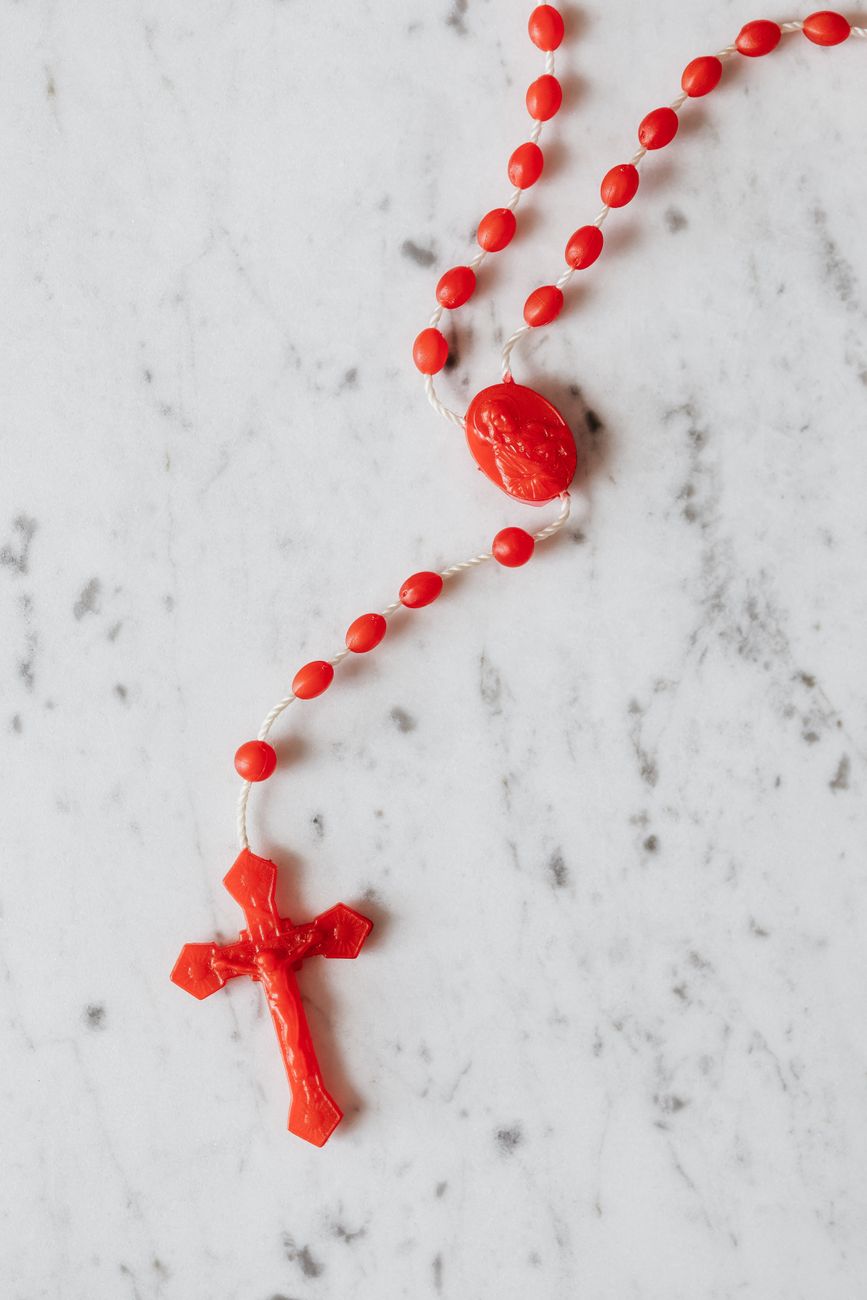
While growing up I never prayed the Rosary much. The prayers seemed so long and mysterious. It was a part of my faith that seemed as if it was always there, although I never knew much about it. Back then I believed that it was a form of prayer that was for “older” people or those wiser than me. It wasn’t until later in life that I started paying more attention to it. My mother and a friend pray the Rosary daily, and three friends always keep one in their pockets. After thinking about their experiences and my faith renewal in Cursillo, I challenged myself to pray it more often. Since then, I have grown to know how powerful it can be, and how spiritually rewarding it can be. I now pray it at least once a week, and in Adoration of the Blessed Sacrament when I am there. I am writing this post to share what I’ve found about the Rosary’s origins and traditions in our faith.
The Rosary is not in the Bible but is one of our faith’s most powerful prayers (Rice, 2021, p. 111). The form that we know today was started by St. Dominic who had a vision of Mary in 1214 A.D. The Blessed Mother told him to pray the Rosary and even showed him a pair pf Rosary beads (Dynamic Catholic). St. Dominic used the Rosary as a powerful weapon in spiritual battles. The Joyful, Glorious, and Sorrowful mysteries were developed in the early 1400s by Dominic of Prussia, while the Luminous Mysteries were adopted by Pope John Paul II in 2002 (Dynamic Catholic). In 1917 the Blessed Mother appeared to three children in Fatima, Portugal, asking them to pray the Rosary every day for world peace. She also invited them to add a short prayer to every decade (O my Jesus, forgive us our sins…). This prayer is now known as the Fatima Prayer (Dynamic Catholic).
Bob Rice (2021, p. 110) writes that although the Blessed Mother has no divine power of her own, she loves us and prays for us. He also provides a passage from Scripture that explains the source of the Rosary’s power: “Fervent prayer of a righteous person is very powerful” (James 5:16).” Brant Pitre (2018, p. 190) writes that Jesus, from the cross, invites all of us to enter a personal relationship with Mary as our spiritual mother. Jesus loves us so much that He gives us His mother to be our mother; she knows our sufferings and prays for us. (p. 191). When we take Mary as our own mother, we will find that she has been praying for us long before we began to talk with her (Pitre, 2018, p. 192).
Dynamic Catholic. A Brief History of the Rosary. Retrieved October 6, 2026, from https://www.dynamiccatholic.com/rosary/history-of-the-rosary.html?srsltid=AU7gw4WFP6rs_CX7CTxIx_PE0krVzmLi3Y3iHsns8iy6hDfUW8j-e7wp
Pitre, B. (2018). Jesus and the Jewish Roots of Mary: Unveiling the Mother of the Messiah. Image.
Rice, B. (2021). Discipleship Quad Guidebook, Part 3. Franciscan University of Steubenville.
Leave a Reply